The Prestige and Tradition of Air Force and Military Challenge Coins
Among the most revered symbols of camaraderie, valor, and belonging in the armed forces, few artifacts carry as much weight as the military challenge coin. Within the United States Air Force, these medallions—often referred to as air force challenge coins—represent more than mere metal discs. They embody shared sacrifice, unit pride, and a history that stretches back through decades of service. To hold one is to hold a piece of that legacy in your palm.
This article explores the rich world of air force challenge coins and military challenge coins, tracing their origins, their role in modern service, and why they continue to matter deeply to those who serve.
The Origins of the Military Challenge Coin
The exact genesis of the military challenge coin tradition is debated, but one of the most enduring stories traces back to World War I. A wealthy lieutenant ordered bronze medallions for his squadron, stamped with their emblem. One pilot kept his coin in a leather pouch around his neck. When his plane was shot down behind enemy lines and he was captured by the French, he used that coin—and its German insignia—to prove his identity and secure a means of escape. From that moment, the coin became a symbol of survival.
Over time, the tradition spread across all branches, but the air force challenge coin developed its own distinct flavor. In the United States Air Force, these coins are often awarded for exceptional performance, as a token of appreciation from commanders, or as a memento of a specific deployment or mission. They are given in moments of triumph, of farewell, and of remembrance.
What Sets Air Force Challenge Coins Apart
While all military challenge coins share common design elements—unit insignia, mottos, and symbolic imagery—air force challenge coins often incorporate aviation-related motifs. Wings, propellers, jets, stars, and clouds frequently appear. The coins may commemorate specific aircraft, such as the B-52 Stratofortress or the F-35 Lightning II, or honor particular squadrons like the Thunderbirds.
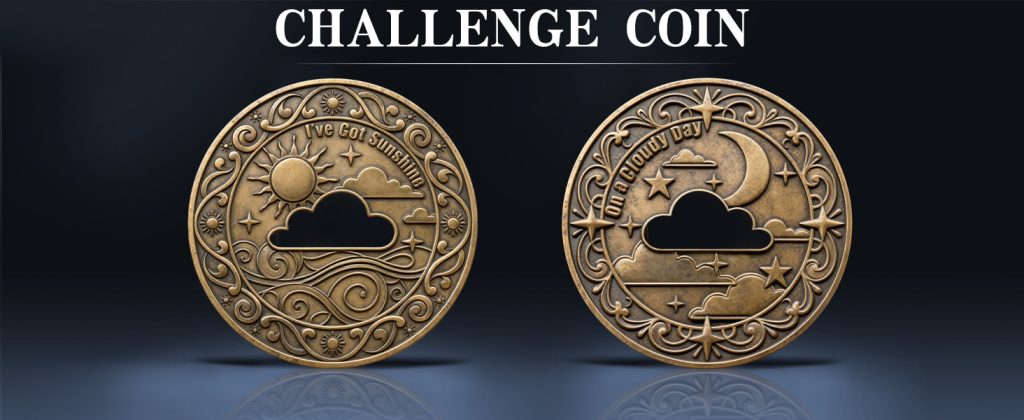
The craftsmanship is meticulous. Many air force challenge coins feature detailed enamel work, raised relief, and even tactile elements like spinning compasses or cut-out shapes. Each coin tells a story. A coin from the 100th Air Refueling Wing might feature a fuel tanker mid-air, while a coin from the 48th Fighter Wing could depict an F-15 Eagle breaking the sound barrier. These are not generic souvenirs; they are bespoke emblems of identity.
The Coin Check Tradition
One cannot discuss military challenge coins without addressing the ritual that gives them their name: the coin check. This tradition requires service members to carry their unit’s coin at all times. If a commander or senior non-commissioned officer calls a coin check, everyone present must produce their coin. Failure to do so often results in buying a round of drinks for the group or performing a silly task.
Within the Air Force, this tradition is both a bonding exercise and a mark of readiness. To be without your air force challenge coin is to be caught off guard—a minor embarrassment that reinforces the habit of preparedness. The stakes are usually lighthearted, but the underlying principle is serious: you carry your unit with you, always.
Designing a Challenge Coin: A Labor of Legacy
Creating a new military challenge coin is a thoughtful process. Squadrons, wings, and even individual units collaborate with designers to capture their essence. The front of the coin typically features the unit’s crest or motto. The reverse might list key deployments, a significant date, or a symbolic image such as an eagle, a globe, or a pair of wings.
For air force challenge coins, the design often reflects the core values of the service: Integrity First, Service Before Self, and Excellence in All We Do. Colors matter too—deep blue for the sky, silver for aircraft, gold for excellence. Some coins are edged with rope borders, others with stars. Each choice is deliberate.
The minting process itself is an art. Dies are cut, metals are pressed, and enamels are baked into the recesses. The result is a coin that is both durable and beautiful—made to be carried through deployments, kept in pockets, and handed down to future generations.
Collecting and Commemorating
Beyond their official use, air force challenge coins have become highly sought-after collectibles. Veterans, active-duty personnel, and civilian enthusiasts alike trade, buy, and display these coins. Some collections number in the hundreds, each coin representing a different unit, a different mission, or a different chapter of service.
For many retirees, their military challenge coin collection serves as a tactile history of their career. A coin from their first tech school, another from a deployment to the Middle East, one from a change of command ceremony, and another from a retirement ceremony. Together, they map a life of service.
Coin displays are common in Air Force offices, VFW halls, and private homes. Shadow boxes with velvet-lined slots allow collectors to arrange their coins by branch, by era, or by personal significance. Each coin is a conversation piece, an anchor for stories that might otherwise fade.
The Modern Role of Military Challenge Coins
In today’s Air Force, the tradition remains strong. Military challenge coins are presented by commanders to recognize outstanding performance, by visiting dignitaries as gifts, and by retiring service members to their closest colleagues. They are also sold in base exchanges, often featuring current operations or anniversary designs.
The coin has even entered the realm of civilian life. Law enforcement agencies, fire departments, and corporate teams have adopted the tradition of challenge coins to build morale and recognize achievement. The origin, however, remains firmly rooted in the military. Every air force challenge coin carries that lineage with it.
Why They Matter
At its core, the military challenge coin is about connection. It links the present to the past, the individual to the unit, and the service member to the values they uphold. When a commander hands an air force challenge coin to a young airman, they are not just giving a token. They are saying: You belong. You matter. You are part of something greater than yourself.
In a world of digital communication and fleeting moments, the challenge coin endures as something real. It has weight. It has texture. It has history. And for those who have served—especially in the United States Air Force—it has meaning that cannot be replicated.
Conclusion: A Tradition Worth Preserving
Whether you are a veteran looking to expand your collection, an active-duty airman receiving your first coin, or a civilian seeking to understand the culture of the armed forces, air force challenge coins and military challenge coins offer a window into a world of honor, discipline, and brotherhood. They are small in size but immense in significance. They are, in many ways, the true currency of service.
So the next time you see one—maybe in a shadow box, maybe on a commander’s desk, maybe in the palm of a veteran’s hand—remember the stories it carries. And if you are ever called to a coin check, make sure you are ready.